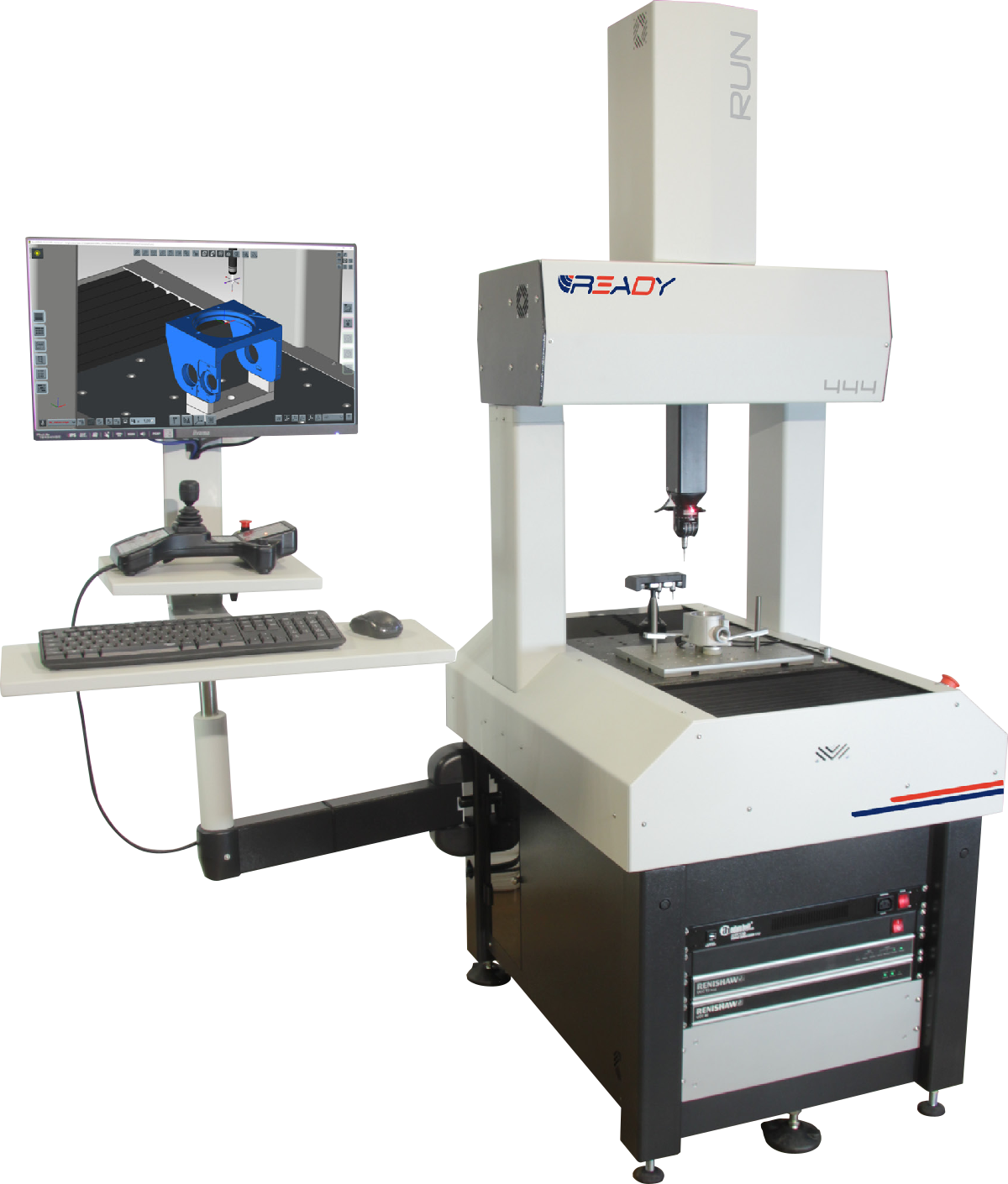
When discussing shop-floor metrology, the focus often falls on software and sensors. However, the true difference between reliable measurements and missed defects lies in the “bones” of the machine: its architectural structure.
In the workshop—unlike a protected laboratory—a machine must battle vibrations, dust, and thermal fluctuations. Here is why mechanical architecture is the first factor to evaluate:
Shop-floor machines are generally divided into two main categories: bridge structures and cantilever (single-arm) structures.
Cantilever Structure: Used by several manufacturers, it focuses on cost-effectiveness, compactness, and three-sided accessibility. However, the typical overhang of this design can present challenges in terms of geometric stability compared to a closed bridge.
Bridge Structure (Ready RUN): The bridge design offers superior intrinsic rigidity and a higher natural frequency. In a production environment, this translates to fewer vibrations and a real-world precision that is much closer to the laboratory specifications.
A further fundamental distinction concerns what actually moves during measurement. Most conventional CMMs use a “moving bridge” (Mobile Gantry) that slides over the part. Ready’s approach with the RUN series is radically different: the bridge is fixed, and the measuring table is what moves. This approach offers decisive technical advantages:
Reduced Inertia: Since no acceleration or braking forces act on the bridge (which holds the measuring head), the structure undergoes zero mechanical stress.
Low Center of Gravity: The fixed bridge design ensures a lower center of gravity, improving overall structural stability.
Precision Life Cycle: The stability of the fixed bridge allows accuracy to remain unchanged for much longer, drastically reducing maintenance costs over time.

Structure doesn’t just influence microns; it affects the speed of your workflow. Intelligent design allows for integrations that other architectures make costly or complex.
For example, the RUN structure allows for total frontal extraction of the table. This means the part moves completely out of the bridge’s footprint, facilitating manual or robotic loading without the risk of collision with the measuring head.
In automated cells, this results in faster cycles because the robot does not have to wait for safety clearance to enter the CMM’s workspace.
Choosing a CMM with a solid, shop-floor-ready structure is the first step toward achieving reliable results directly in production. While laboratory specs may look similar on paper, mechanical stability makes the difference when a CMM is placed in the same environment as presses, lathes, and forklifts.